The Catalogue of Shipwrecked Books: Young Columbus and the Quest for a Universal Library by Edward Wilson-Lee
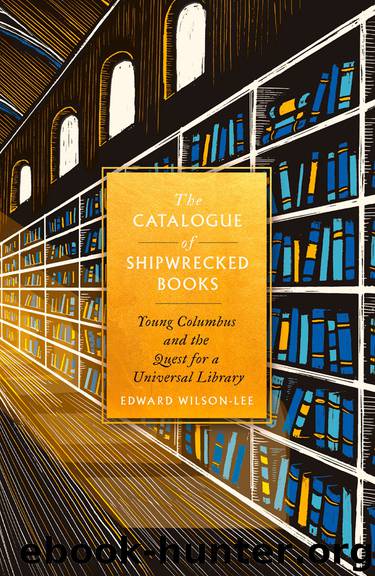
Author:Edward Wilson-Lee [Wilson-Lee, Edward]
Language: eng
Format: epub
Tags: Adventurers & Explorers, Biographies & Memoirs, Europe, Historical, History, Renaissance, Spain
ISBN: 9780008146221
Google: OhmVswEACAAJ
Amazon: B077MDP4CK
Publisher: William Collins
Published: 2018-05-04T04:00:00+00:00
If we are forbidden to use the inventions of the pagan world, what shall we have left I ask you, in the fields, in the towns, in churches and houses and workshops, at home, at war, in private and in public? To such an extent it is true that we Christians have nothing we have not inherited from the pagans. The fact that we write Latin, speak it in one way or another, comes to us from the pagans; they discovered writing, they invented the use of speech.
It was this spirit of radical openness – believing knowledge was a good in itself and should be made widely available – that drove the programme of Erasmus and other humanists to hunt down the best writings wherever they could be found. This not only involved tracking down lost books wherever they might be – as when in 1516 Erasmus charged a friend to search the land of the Dacians for a fabled tower of ancient books – but then also working with the great printers of the age to make them available in robust editions – greatly handsome and precise, of course, but made to go out into the world and be used. Hernando, in his library open to all books in all subjects from within Christendom and without, and in the tools he would use it to produce, would build on these foundations in ways Erasmus could not have begun to imagine.5
Hernando left a fitting monument to Erasmus in one of the crucial building blocks of his library, which certainly existed in an early form by this point. This was his Abecedarium, or alphabetical list of authors and book titles contained in the library. In the final version of the Abecedarium Erasmus is one of only two modern authors to have a section of their own separate from the main list, where in the back of the catalogue Hernando records 185 separate works by Erasmus contained in the library (the identity of the second author will become important in due course). In a sense, given that Hernando sought to acquire every book he could find for the library, this is less a personal tribute to Erasmus than a simple witness to his presence in the world of the early printed book: the great humanist, a million copies of whose writings are estimated to have been printed during his life, had simply overflowed from his place in the alphabetical lists, forcing Hernando to remove him to a separate supplement. If on the one hand Hernando’s catalogue is simply recognising Erasmus as a prolific author, however, it is also true (in another, rather counter-intuitive sense) that the very notion of an ‘author’ is created by lists like Hernando’s. As the number of books available to collectors like him grew, and new ways of organising them became necessary, a list of authors in alphabetical order probably seemed a fairly unproblematic place to start. This kind of list, after all, is only using a memorable
Download
This site does not store any files on its server. We only index and link to content provided by other sites. Please contact the content providers to delete copyright contents if any and email us, we'll remove relevant links or contents immediately.
Endurance: Shackleton's Incredible Voyage by Alfred Lansing(4786)
The Motorcycle Diaries by Ernesto Che Guevara(4105)
Alive: The Story of the Andes Survivors by Piers Paul Read(4035)
Tokyo Vice: An American Reporter on the Police Beat in Japan by Jake Adelstein(3997)
Exit West by Mohsin Hamid(3829)
Apollo 8 by Jeffrey Kluger(3713)
Aleister Crowley: The Biography by Tobias Churton(3642)
Annapurna by Maurice Herzog(3474)
Full Circle by Michael Palin(3452)
Into Thin Air by Jon Krakauer(3402)
Kitchen confidential by Anthony Bourdain(3093)
In Patagonia by Bruce Chatwin(2935)
A Wilder Time by William E. Glassley(2863)
Finding Gobi by Dion Leonard(2846)
The Ogre by Doug Scott(2686)
Into the Wild by Jon Krakauer(2635)
The Stranger in the Woods by Michael Finkel(2538)
L'Appart by David Lebovitz(2520)
An Odyssey by Daniel Mendelsohn(2309)
